
原文地址:http://news.sciencenet.cn/htmlnews/2023/9/507710.shtm
編譯 | 李言Nature, 31 August 2023, Volume 620 Issue 7976
《自然》2023年8月31日,第620卷,7976期
天文學Astronomy
A binary pulsar in a 53-minute orbit軌道周期為53分鐘的脈沖星雙星系統
▲ 作者:Z. Pan, J. G. Lu, P. Jiang et al.
▲ 鏈接:
https://www.nature.com/articles/s41586-023-06308-w
▲ 摘要:
蜘蛛類脈沖星是一種近軌道上有一顆伴星的中子星。伴星向中子星釋放物質,使其旋轉至毫秒周期,而軌道縮短至小時內。
在此,我們報告對雙毫秒脈沖星PSR J1953+1844 (M71E)的射電觀測,它的軌道周期為53.3分鐘,伴星質量約為0.07 M⊙。它是一個微弱的x射線源,距離球狀星團M71的中心2.5弧分。
▲ Abstract:
Spider pulsars are neutron stars that have a companion star in a close orbit. The companion star sheds material to the neutron star, spinning it up to millisecond rotation periods, while the orbit shortens to hours. Here we report radio observations of the binary millisecond pulsar PSR J1953+1844 (M71E) that show it to have an orbital period of 53.3?minutes and a companion with a mass of around 0.07?M⊙. It is a faint X-ray source and located 2.5?arcminutes from the centre of the globular cluster M71.
化學Chemistry
First observation of 28O
首次檢測到氧-28
▲ 作者:Y. Kondo, N. L. Achouri et al.
▲ 鏈接:
https://www.nature.com/articles/s41586-023-06352-6
▲ 摘要:
在此,我們報告了通過它們衰變成氧-24和4個中子,第一次觀察到了氧-28和氧-27。氧-28的核是非常有趣,因為它有8個質子和20個中子這樣“神奇”的數字,在核結構的標準殼層模型圖像中,它預計是相對少數所謂的“雙重神奇”核之一。
氧-28和氧-27都被發現存在狹窄的低共振,它們的衰變能量在這里與復雜的理論模型的結果進行了比較,包括大規模的殼模型計算和新開發的統計方法。
在這兩種情況下,潛在的核相互作用都是從量子色動力學的有效場論推導出來的。最后,結果表明,氟-29梁產生氧-28的截面與不呈現封閉20個中子殼結構的截面一致。
▲ Abstract:
Here we report on the first observation of 28O and 27O through their decay into 24O and four and three neutrons, respectively. The 28O nucleus is of particular interest as, with the Z?=?8 and N?=?20 magic numbers, it is expected in the standard shell-model picture of nuclear structure to be one of a relatively small number of so-called ‘doubly magic’ nuclei. Both 27O and 28O were found to exist as narrow, low-lying resonances and their decay energies are compared here to the results of sophisticated theoretical modelling, including a large-scale shell-model calculation and a newly developed statistical approach. In both cases, the underlying nuclear interactions were derived from effective field theories of quantum chromodynamics. Finally, it is shown that the cross-section for the production of 28O from a 29F beam is consistent with it not exhibiting a closed N?=?20 shell structure.
物理學Physics
Frustration- and doping-induced magnetism in a Fermi–Hubbard simulator
費米-哈伯德模擬器中阻挫和摻雜誘導的磁力現象
▲ 作者:Muqing Xu, Lev Haldar Kendrick et al.
▲ 鏈接:
https://www.nature.com/articles/s41586-023-06280-5
▲ 摘要:
在此,我們在各向異性光學晶格中使用從正方形到三角形連續可調諧的超冷費米子,研究了具有可控挫折和摻雜的哈伯德模型的局部自旋有序現象。
在半填充和強相互作用U/t≈9時,我們在單點水平上觀察到挫折如何減小磁相關的范圍,并驅動從共線奈爾反鐵磁體到短程相關120°螺旋相的轉變。
在半填充之外,三角形極限顯示了在空穴摻雜側反鐵磁相關增強,而在粒子摻雜超過20%時,鐵磁關聯反轉提示了動力學磁性在阻挫系統中的作用。這項工作為探索三角形晶格中可能的手性有序相或超導相鋪平了道路,并實現了可能是描述銅材料超導性所必需的t-t "方形晶格哈伯德模型
▲ Abstract:
Here we investigate the local spin order of a Hubbard model with controllable frustration and doping, using ultracold fermions in anisotropic optical lattices continuously tunable from a square to a triangular geometry. At half-filling and strong interactions U/t?≈?9, we observe at the single-site level how frustration reduces the range of magnetic correlations and drives a transition from a collinear Néel antiferromagnet to a short-range correlated 120° spiral phase. Away from half-filling, the triangular limit shows enhanced antiferromagnetic correlations on the hole-doped side and a reversal to ferromagnetic correlations at particle dopings above 20%, hinting at the role of kinetic magnetism in frustrated systems. This work paves the way towards exploring possible chiral ordered or superconducting phases in triangular lattices and realizing t–t′ square lattice Hubbard models that may be essential to describe superconductivity in cuprate materials.
人工智能Artificial Intelligence
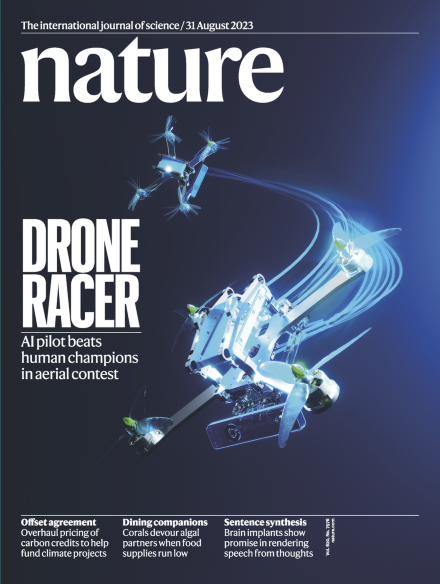
Champion-level drone racing using deep reinforcement learning
使用深度強化學習的冠軍級無人機
▲ 作者:Elia Kaufmann, Leonard Bauersfeld et al.
▲ 鏈接:
https://www.nature.com/articles/s41586-023-06419-4
▲ 摘要:
在此,我們介紹Swift,一個可以與人類世界冠軍水平的車輛比賽的自主系統。該系統結婚了模擬中的深度強化學習(RL)與物理世界中收集的數據。Swift在現實世界中與三位人類冠軍進行了正面交鋒,其中包括兩個國際聯賽的世界冠軍。
Swift在與每一位人類冠軍的較量中都贏得了幾場比賽,并創下了最快的比賽時間。這項研究代表了移動機器人和機器智能的一個里程碑,它可能會激發在其他物理系統中部署基于混合學習的解決方案。
▲ Abstract:
Here we introduce Swift, an autonomous system that can race physical vehicles at the level of the human world champions. The system combines deep reinforcement learning (RL) in simulation with data collected in the physical world. Swift competed against three human champions, including the world champions of two international leagues, in real-world head-to-head races. Swift won several races against each of the human champions and demonstrated the fastest recorded race time. This work represents a milestone for mobile robotics and machine intelligence, which may inspire the deployment of hybrid learning-based solutions in other physical systems.
環境科學Environmental Science
Agricultural pesticide land budget and river discharge to oceans
農藥土地預算以及河流向海洋的排放
▲ 作者:Federico Maggi, Fiona H. M. Tang & Francesco N. Tubiello
▲ 鏈接:
https://www.nature.com/articles/s41586-023-06296-x
▲ 摘要:
在此,我們開發了一個過程模型,計算了92種最常用的農業農藥活性物質的水文和生物地球化學,以評估它們通過世界主要流域的途徑,并繪制了全球陸地和河流預算的近況,包括向海洋的排放。本研究表明2015年使用的農藥年凈投入量為0.94Tg,其中82%被生物降解,10%殘留在土壤中,7.2%浸出至根區以下。
通過排水,河流以每年每公里?10至100公斤以上的速率吸收0.73克農藥。與土壤中的情況相反,進入河流的農藥中只有1.1%沿著溪流降解,在超過13000公里長度的河流中超過安全水平(濃度大于1 μg l?1),每年有0.71克農藥流入海洋。除草劑是土地(72%)和河流入海(62%)中的主要農藥殘留。
▲ Abstract:
Here, we develop a process-based model accounting for the hydrology and biogeochemistry of the 92 most used agricultural pesticide active substances to assess their pathways through the principal catchments of the world and draw a near-present picture of the global land and river budgets, including discharge to oceans. Of the 0.94?Tg net annual pesticide input in 2015 used in this study, 82% is biologically degraded, 10% remains as residue in soil and 7.2% leaches below the root zone. Rivers receive 0.73?Gg of pesticides from their drainage at a rate of 10 to more than 100?kg?yr?1km?1. By contrast to their fate in soil, only 1.1% of pesticides entering rivers are degraded along streams, exceeding safety levels (concentrations >1 μg l?1) in more than 13,000 km of river length, with 0.71?Gg of pesticide active ingredients released to oceans every year. Herbicides represent the prevalent pesticide residue on both land (72%) and river outlets (62%).
生物學Biology
原文地址:http://news.sciencenet.cn/htmlnews/2024/3/518827.shtm編譯|未玖Science, 8MAR2024,VOL383,ISSUE66......
原文地址:http://news.sciencenet.cn/htmlnews/2024/2/517230.shtm編譯|馮維維SCIENCE, Volume383,Issue6682,2F......
原文地址:http://news.sciencenet.cn/htmlnews/2023/9/507710.shtm編譯|李言Nature, 31August2023,Volume620Is......
原文地址:http://news.sciencenet.cn/htmlnews/2023/7/504851.shtmScience,14JUL2023,VOL381,ISSUE6654《科學》2023......