
原文地址:http://news.sciencenet.cn/htmlnews/2024/3/518827.shtm
編譯 | 未玖
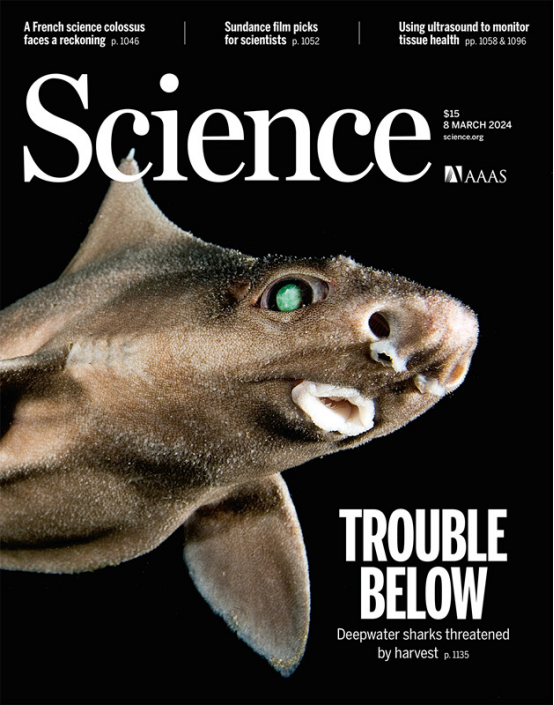
Science, 8 MAR 2024, VOL 383, ISSUE 6687
《科學》2024年3月8日,第383卷,6687期
物理學Physics
Adaptive optical imaging with entangled photons
糾纏光子的自適應光學成像
▲ 作者:Patrick Cameron, Baptiste Courme, Chloé Vernière, Raj Pandya, Daniele Faccio & Hugo Defienne
▲ 鏈接:
https://www.science.org/doi/10.1126/science.adk7825
▲ 摘要:
自適應光學(AO)通過校正光學像差,顛覆了從天文學到顯微學等領域的成像。然而,在無標記顯微鏡中,由于缺乏引導星和需要選擇特定于樣品和成像過程的優化度量,傳統的AO面臨局限性。
研究組提出了一種利用糾纏光子之間的相關性來直接校正點擴散函數的AO方法。這種無引導星方法獨立于標本和成像方式。他們演示了在存在像差的情況下使用明場成像裝置對生物樣本進行成像,該裝置使用空間糾纏光子對源進行操作。
該方法在校正特定像差方面比傳統的AO表現更優,特別是那些涉及大量散焦的像差。該工作改善了無標記顯微鏡的AO,并有望在量子顯微鏡的發展中發揮重要作用。
▲ Abstract:
Adaptive optics (AO) has revolutionized imaging in fields from astronomy to microscopy by correcting optical aberrations. In label-free microscopes, however, conventional AO faces limitations because of the absence of a guide star and the need to select an optimization metric specific to the sample and imaging process. Here, we propose an AO approach leveraging correlations between entangled photons to directly correct the point spread function. This guide star–free method is independent of the specimen and imaging modality. We demonstrate the imaging of biological samples in the presence of aberrations using a bright-field imaging setup operating with a source of spatially entangled photon pairs. Our approach performs better than conventional AO in correcting specific aberrations, particularly those involving substantial defocus. Our work improves AO for label-free microscopy and could play a major role in the development of quantum microscopes.
Multimodality integrated microresonators using the Moiré speedup effect
利用莫爾加速效應的多模集成微諧振器
▲ 作者:Qing-Xin Ji, Peng Liu, Warren Jin, Joel Guo, Lue Wu, Zhiquan Yuan, et al.
▲ 鏈接:
https://www.science.org/doi/10.1126/science.adk9429
▲ 摘要:
高Q微諧振器是光子集成電路中不可或缺的元件,提供了幾種可用的工作模式。然而,這些模式不能在制造后重新配置,因其由諧振器的物理幾何形狀來固定。
在這項工作中,研究組提出了一種莫爾加速色散調諧方法,使微諧振器器件能夠在三種模式中的任何一種模式下工作。游標耦合環的電調諧可根據需要使用相同的混合集成設備將操作模式切換為布里淵激光器、亮微梳和暗微梳操作。
研究組演示了電信C波段的布里淵相位匹配和微梳操作。同樣,通過使用單泵浦波長,可以切換操作模式。因此,這種通用設計可適用于一系列應用。該器件為集成光子電路帶來了靈活的混合模式操作。
▲ Abstract:
High-Q microresonators are indispensable components of photonic integrated circuits and offer several useful operational modes. However, these modes cannot be reconfigured after fabrication because they are fixed by the resonator’s physical geometry. In this work, we propose a Moiré speedup dispersion tuning method that enables a microresonator device to operate in any of three modes. Electrical tuning of Vernier coupled rings switches operating modality to Brillouin laser, bright microcomb, and dark microcomb operation on demand using the same hybrid-integrated device. Brillouin phase matching and microcomb operation across the telecom C-band is demonstrated. Likewise, by using a single-pump wavelength, the operating mode can be switched. As a result, one universal design can be applied across a range of applications. The device brings flexible mixed-mode operation to integrated photonic circuits.
材料科學Materials ScienceBioresorbable shape-adaptive structures for ultrasonic monitoring of deep-tissue homeostasis
用于超聲監測深層組織穩態的生物可吸收形狀自適應結構
▲ 作者:Jiaqi Liu, Naijia Liu, Yameng Xu, Mingzheng Wu, Haohui Zhang, Yue Wang, et al.
▲ 鏈接:
https://www.science.org/doi/10.1126/science.adk9880
▲ 摘要:
監測體內平衡是獲得病理生理學見解以治療患者的一個重要方面。準確、及時地評估深層組織內穩態失調通常需要昂貴的成像技術或侵入性活檢。
研究組介紹了一種生物可吸收的形狀自適應材料結構,可使用常規超聲儀實時監測深層組織穩態。通過手術植入或注射器注射,將可生物吸收的小金屬盤分布在薄pH響應水凝膠中,可實現基于超聲的pH時空變化測量,用于胃腸道手術后吻合口瘺的早期評估,且在恢復期后其生物吸收性避免了再次手術取出。
在小型和大型動物模型中的演示證明了該結構監測小腸、胃和胰腺滲漏的能力。
▲ Abstract:
Monitoring homeostasis is an essential aspect of obtaining pathophysiological insights for treating patients. Accurate, timely assessments of homeostatic dysregulation in deep tissues typically require expensive imaging techniques or invasive biopsies. We introduce a bioresorbable shape-adaptive materials structure that enables real-time monitoring of deep-tissue homeostasis using conventional ultrasound instruments. Collections of small bioresorbable metal disks distributed within thin, pH-responsive hydrogels, deployed by surgical implantation or syringe injection, allow ultrasound-based measurements of spatiotemporal changes in pH for early assessments of anastomotic leaks after gastrointestinal surgeries, and their bioresorption after a recovery period eliminates the need for surgical extraction. Demonstrations in small and large animal models illustrate capabilities in monitoring leakage from the small intestine, the stomach, and the pancreas.
Attosecond-pump attosecond-probe x-ray spectroscopy of liquid water
液態水的阿秒-泵浦/阿秒-探針X射線光譜學
▲ 作者:Shuai Li, Lixin Lu, Swarnendu Bhattacharyya, Carolyn Pearce, Kai Li, Emily T. Nienhuis, et al.
▲ 鏈接:
https://www.science.org/doi/10.1126/science.adn6059
▲ 摘要:
阿秒-泵浦/阿秒-探針實驗長期以來一直被認為是實時觀察電子動力學的最直接方法。雖然近紅外飛秒和極紫外阿秒脈沖的疊加與理論相結合已取得了很大成功,但真正的阿秒-泵浦/阿秒-探針實驗仍然受限。
研究組利用來自X射線自由電子激光器的同步阿秒X射線脈沖對,通過全X射線阿秒瞬態吸收光譜(AX-ATAS)研究了液態水中對價電離的電子響應。
該分析表明,AX-ATAS響應局限于亞飛秒時間尺度,消除了任何氫原子運動,并通過實驗證明X射線發射光譜中的1b1分裂與動力學有關,而不是環境液態水中存在兩個結構基元的證據。
▲ Abstract:
Attosecond-pump/attosecond-probe experiments have long been sought as the most straightforward method for observing electron dynamics in real time. Although there has been much success with overlapped near-infrared femtosecond and extreme ultraviolet attosecond pulses combined with theory, true attosecond-pump/attosecond-probe experiments have been limited. We used a synchronized attosecond x-ray pulse pair from an x-ray free-electron laser to study the electronic response to valence ionization in liquid water through all x-ray attosecond transient absorption spectroscopy (AX-ATAS). Our analysis showed that the AX-ATAS response is confined to the subfemtosecond timescale, eliminating any hydrogen atom motion and demonstrating experimentally that the 1b1 splitting in the x-ray emission spectrum is related to dynamics and is not evidence of two structural motifs in ambient liquid water.
地球科學Earth Science
CO2 drawdown from weathering is maximized at moderate erosion rates
溫和侵蝕速率最大限度地減少了風化產生的CO2
▲ 作者:Aaron Bufe, Jeremy K. C. Rugenstein & Niels Hovius
▲ 鏈接:
https://www.science.org/doi/10.1126/science.adk0957
▲ 摘要:
抬升和侵蝕通過使礦物暴露于化學風化作用來調節地質時間尺度上的碳循環。然而,礦物風化的侵蝕敏感性仍然難以量化。
來自不同造山帶山溪的溶質化學數據集分離出了侵蝕對硅酸鹽風化(CO2匯)和硫化物-碳酸鹽耦合物風化(CO2源)的影響。這些影響的對比侵蝕敏感性在每年約0.07毫米的侵蝕速率下造成最大幅度的二氧化碳減少。
因此,溫和抬升速率的地貌增強了地球的無機CO2匯,而更快速的抬升則減少甚至逆轉了CO2的封存。CO2減少的“最佳侵蝕”概念調和了關于造山對碳循環影響的相互矛盾的觀點,有望實現根據構造變化對地質CO2通量進行估計。
▲ Abstract:
Uplift and erosion modulate the carbon cycle over geologic timescales by exposing minerals to chemical weathering. However, the erosion sensitivity of mineral weathering remains difficult to quantify. Solute-chemistry datasets from mountain streams in different orogens isolate the impact of erosion on silicate weathering—a carbon dioxide (CO2) sink—and coupled sulfide and carbonate weathering—a CO2 source. Contrasting erosion sensitivities of these reactions produce a CO2-drawdown maximum at erosion rates of ~0.07 millimeters per year. Thus, landscapes with moderate uplift rates bolster Earth’s inorganic CO2 sink, whereas more rapid uplift decreases or even reverses CO2 sequestration. This concept of an “erosion optimum” for CO2 drawdown reconciles conflicting views on the impact of mountain building on the carbon cycle and permits estimates of geologic CO2fluxes dependent upon tectonic changes.
原文地址:http://news.sciencenet.cn/htmlnews/2024/3/518827.shtm編譯|未玖Science, 8MAR2024,VOL383,ISSUE66......
原文地址:http://news.sciencenet.cn/htmlnews/2024/2/517230.shtm編譯|馮維維SCIENCE, Volume383,Issue6682,2F......
原文地址:http://news.sciencenet.cn/htmlnews/2023/9/507710.shtm編譯|李言Nature, 31August2023,Volume620Is......
原文地址:http://news.sciencenet.cn/htmlnews/2023/7/504851.shtmScience,14JUL2023,VOL381,ISSUE6654《科學》2023......