
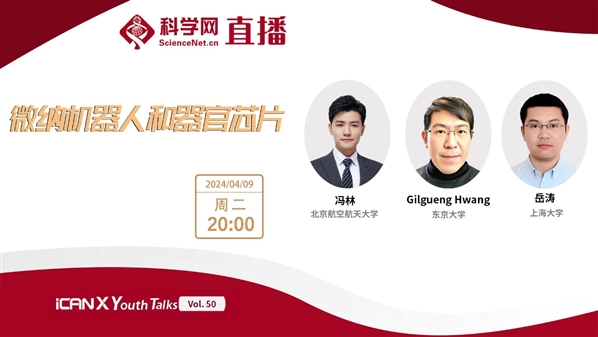
直播時間:2024年4月9日(周二)20:00-22:00
直播平臺:

科學網APP
(科學網微博直播間鏈接)

科學網微博

科學網視頻號
北京時間4月9日晚八點,iCANX Youth Talks第五十期邀請到了北京航空航天大學Lin Feng,東京大學Gilgueng Hwang,上海大學Tao Yue三位教授主講,北京大學Haixia Zhang作為主持人,北京大學第三醫院醫學創新研究院中心Jiaying Zhang,首都醫科大學Xue Bai擔任嘉賓,期待你一起加入這場知識盛宴。
【嘉賓介紹】

Lin Feng
北京航空航天大學
Optoelectronic-tweezer micromanipulation and magnetically controlled micronanorobot
【Abstract】
Cancer is a major problem in the history of human diseases that has not yet been conquered, according to the 2020 China Tumor Registry Annual Report, the number of cancer patients in China has exceeded ten million, and the number of new patients is nearly 4.8 million per year, accounting for about 1/4 of the worlds population. chemotherapy is still the commonly used method, but the side effects of chemotherapy cause great pain to the patients. According to the statistics, the effective utilization rate of targeted drugs is still less than 5 per thousand, and the rapid development of micro-nano technology and material science has provided mankind with a lot of new microscopic means of solving the problem, among which micro-nano robots have been expected to be used for in vivo drug delivery and cellular microsurgery analysis since the end of the last century. Micro-nano robots make full use of micro-nano manufacturing and control technology to give new meaning to robots, which has attracted much attention from the world. Especially in the field of biomedicine, drug-carrying micro-nano robots have unlimited application potential, which will inevitably cause new changes in precision medicine, targeted drugs and other technologies. The use of micro-nanorobotics control technology will be an effective solution to a series of problems such as low utilization of traditional chemotherapeutic drugs and targeted drugs, intolerance of the human body, large side effects, etc., and the combination of immunotherapy is expected to become a new science and technology that overturns the traditional therapeutic program. We provide smarter and more efficient solutions for tumor treatment by utilizing optoelectronic tweezers non-contact manipulation technology and micro-nano-robotic technology, among others.
癌癥是人類疾病史上仍未攻克的重大難題,據《2020中國腫瘤登記年報》統計我國目前癌癥患者突破千萬,新增數量每年近 480 萬,約占全世界的 1/4。化療仍然是常用辦法,但是化療所帶來的副作用給病人造成極大的痛苦。據統計,目前靶向藥物的有效利用率仍然不足千分之五。微納技術與材料科學的迅猛發展為人類提供了許多全新的微觀解決手段,其中,微納機器人自上世紀末就被期盼用于體內藥物輸送、細胞微手術分析等。微納機器人技術充分利用微納制造與控制技術,賦予機器人新含義,備受世人矚目。尤其在生物醫學領域,載藥微納機器人具有無限的應用潛力,勢必引起精準醫療、靶向藥物等技術的新變革。利用微納米機器人控制技術將會對傳統化療藥物和靶向藥物藥物利用低,人體不耐受,副反應大等一系列問題的有效解決手段,結合免疫療法有望成為顛覆傳統治療方案的新科技。我們通過利用光電鑷非接觸操作技術和微納米機器人自動化技術等,為腫瘤治療提供更加智能、高效的解決方案。
【BIOGRAPHY】
Feng Lin is a professor and doctoral supervisor under the "Excellence Hundred Plan" of Beijing University of Aeronautics and Astronautics (BUAA). He is a National Young Changjiang Scholar, a recipient of the Beijing Outstanding Young Scientist Fund, and a Beijing Rising Star in Science and Technology. He was selected as a 2011 Japan Society of Mechanical Engineers (JSME) Outstanding Young Scholar, a 2013 Japan Society for the Promotion of Science (JSPS) Scholar, and a 2020 Director of the International Committee on Micro and Nano Robotics of the Institute of Electrical and Electronics Engineers (IEEE). Currently, he serves as Editor of Bio-Design and Manufacturing, Cyborg and Bionic Systems, and Director of Micro and Nano Robotics Branch and Micro and Nano Operators and Actuators Branch of Chinese Society of Micro and Nanotechnology. He has served as an editorial board member and session chair of the international robotics conferences IEEE International Conference on Robotics and Automation (ICRA) and International Conference on Intelligent Robots and Systems (IROS). He has published 150 papers in SCI/EI journals such as International Journal of Robotics Research, Small, Research, Lab on a chip, etc. He has published the textbook "Introduction to Micro and Nano Robotics" and 4 English monographs.
馮林,北京航空航天大學教授,博士生導師,北京市杰出青年科學基金獲得者,北京市科技新星。入選2011年日本機械工程師學會優秀年輕學者、2013年日本學術振興會(JSPS)學者、2020年電氣電子工程師學會(IEEE)國際微納米機器人技術委員會理事。目前擔任Bio-Design and Manufacturing、Cyborg and Bionic Systems編輯,中國微米納米技術學會微納機器人分會、微納操作器與執行器分會理事。曾任國際機器人會議IEEE機器人和自動化國際會議(ICRA)、智能機器人與系統國際會議(IROS)的編委、分會主席。在International Journal of Robotics Research、Small、Research、Lab on a chip等期發表論文SCI/EI 期刊150篇,出版教材《微納米機器人概論》及英文專著共4部。

Gilgueng Hwang
東京大學
On-chip Micro/nanorobotic Swimmers for Biomedical Applications
【ABSTRACT】
Untethered micro/nanorobotic swimmers are promising tools towards biologic or biomedical applications thanks to their highly accessible feature to tiny lumens. However fundamental challenges in design, fabrication due to low Reynolds number physics have limited such applications. We combined multidisciplinary technologies in micro/nanofabrication, microfluidics and robotics to those challenges. We recently developed highly energy efficient and fully controllable on-chip magnetic micro/nanorobotic swimmers with remote controlled functions such as cargo transport and sensing. I will introduce our recently developed micro and nanorobotic swimmers which can serve as on-chip mobile micromanipulators or physical sensors in microfluidic environments. The presentation will be concluded by discussing ongoing and future perspectives toward biomedical applications.
無系繩微納游泳機器人憑借其極易接近微小腔體的特點,成為生物或生物醫學應用領域大有可為的工具。然而,由于低雷諾數物理特性,設計和制造方面的基本挑戰限制了此類應用。我們將微/納米加工、微流體技術和機器人技術等多學科技術相結合,以應對這些挑戰。我們最近開發出了高能效、完全可控的片上磁性微型/納米游泳機器人,具有貨物運輸和傳感等遙控功能。我將介紹我們最近開發的微型和納米游泳機器人,它們可以在微流體環境中用作片上移動微機械手或物理傳感器。最后,我還將討論生物醫學應用的當前和未來前景。
【BIOGRAPHY】
Dr. Gilgueng Hwang received a B.S. degree in electrical engineering from Yonsei University, Seoul, South Korea, an M.S. degree and a Ph.D. degree in electrical engineering from The University of Tokyo, Tokyo, Japan, in 2002, 2005, and 2008. He spent 2 years in ETH Zurich, Switzerland as an academic guest for a collaborative research project. Then he worked as a postdoc for 2 years in ISIR, Sorbonne University, Paris, France. From 2010, he has been working as a CNRS research scientist (Chargé de Recherche) in C2N, Paris-Saclay University, Palaiseau, France. After working as a VDEC D2T project associate professor at the University of Tokyo in 2019, he is currently affected to LIMMS-CNRS, The University of Tokyo, Japan which is an international joint research laboratory between the University of Tokyo and CNRS. His research interest covers 3D/4D MEMS, micro/nanofabrication, micro/nanorobotics, micro/nanofluidics, lab-on-a-chip, artificial organs, organ-on-chip, in-situ SEM characterization, nanomanipulation.
Gilgueng Hwang 于 2002 年、2005 年和 2008 年分別獲得韓國首爾延世大學電氣工程學士學位、日本東京大學電氣工程碩士學位和博士學位。他曾作為學術訪問學者在瑞士蘇黎世聯邦理工學院從事了兩年的合作研究項目。之后,他在法國巴黎索邦大學 ISIR 做了兩年博士后。從 2010 年起,他在法國巴黎帕萊索的巴黎薩克雷大學 C2N 擔任國家科學研究中心研究科學家(Chargé de Recherche)。2019 年在東京大學擔任 VDEC D2T 項目副教授后,他目前受聘于日本東京大學 LIMMS-CNRS,該實驗室是東京大學和法國國家科學研究中心(CNRS)的國際聯合研究實驗室。他的研究興趣包括三維/四維微機電系統、微/納米加工、微/納米機器人、微/納米流體技術、片上實驗室、人工器官、片上器官、原位掃描電鏡表征、納米操縱。

Tao Yue
上海大學
Vascularized Micro-organ-on-a-chip based on Microenvironment Control inside Microfluidic platforms
【ABSTRACT】
The vascular network of the circulatory system plays a vital role in maintaining homeostasis in the human body. We currently developed a novel modular microfluidic system with a vertical two-layered configuration to generate large-scale perfused microvascular networks in vitro. The two-layer PDMS configuration allows the tissue chambers and medium channels not only to be designed and fabricated independently but also to be aligned and bonded accordingly. This method can produce a modular microfluidic system that has high flexibility and scalability to design an integrated platform with multiple perfused vascularized tissues with high densities. The medium channel was designed with a rhombic shape and fabricated to be semi-closed to form a capillary burst valve in the vertical direction, serving as the interface between the medium channels and tissue chambers. Angiogenesis and anastomosis at the vertical interface were successfully achieved by using different combinations of tissue chambers and medium channels. Various large-scale microvascular networks were generated and quantified in terms of vessel length and density. Minimal leakage of the perfused dextran confirmed the lumenization of the microvascular networks and the formation of tight vertical interconnections between the microvascular networks and medium channels in different structural layers. This platform enables the culturing of interconnected, large-scale perfused vascularized tissue networks with high density and scalability for a wide range of multi-organ-on-a-chip applications, including basic biological studies and drug screening.
微環境的變化極大地影響細胞和組織的生長。通過控制微環境不同的關鍵參數,可以有效地對細胞等生物對象進行調控。作為人體最關鍵的組織,血管的生長是一個化學、生理、物理等多種因素共同作用的復雜過程。在人工組織器官的構建中,通過對細胞的環境控制,實現對功能化等關鍵過程的有效控制。通過控制細胞的微環境,包括物理、化學等外界刺激,能夠實現對細胞行為,例如血管生長過程的調控。利用微納操作和控制的方法,結合生物體自身發育和成長的要素,通過細胞微環境的適當控制,讓環境來引導細胞自身去構建細微的血管結構,發展了體外具有功能化的活體血管網絡芯片。同時,通過有效獲取細胞在特定控制條件下表現出來的特征,就能從控制工程的角度建立以微環境為輸入、細胞特性為輸出的模型,推動對細胞和組織,特別是血管網功能化過程中調控機制的研究和理解。
【BIOGRAPHY】
Tao Yue is an Associate Professor in School of Mechatronic Engineering and Automation, Shanghai University. He received the B.S. degree and M.S. degree from Tongji University, Shanghai, China, in 2007 and 2010 respectively, and the Ph.D. degree from Nagoya University, Nagoya, Japan, in 2014. He then worked as a postdoctoral researcher in Ohio State University and University of California, Irvine in US from 2014 to 2018, funded by NSF and NIH. His research interests include Micro/nano robotics, Microfluidic devices and Bio-mems technologies. Prof. Yue has published more than 60 papers in peer-reviewed journals, including Science Advances, Nano Energy, Advanced Science and Lab on a chip. He has given 20 presentations in international conferences (IEEE ICRA, IROS and MicroTAS). He received the Best Paper Award at the IEEE International Symposium on Micro-Nano Mechatronics and Human Science in 2013 and the IEEE Robotics and Automation Society Japan Chapter Young Award in 2014. He was awarded with Shanghai Young Oriental Scholar in 2017, Shanghai Science and Technology Committee Rising-Star Program in 2019 and Second Prize of Award for Technological Invention of Shanghai in 2022.
岳濤,上海大學機電工程與自動化學院副研究員,上海大學微納操作技術研究中心主任,上海高校青年東方學者,上海市青年科技啟明星。主要研究領域包括微納機器人、微流控芯片、智能微機電系統。現任中國微米納米技術學會微納機器人分會理事、中國人工智能學會智能決策專委會副秘書長、中國醫藥生物技術協會3D打印技術分會委員。2003年至2010年在同濟大學學習,獲得機械工程本科和碩士學位。2014年于日本名古屋大學微納米系統工程系取得博士學位,2014年至2018年先后在美國俄亥俄州立大學和加利福尼亞大學歐文分校從事博士后研究,2018加入上海大學。近五年主持和參與國家/省部級項目12項,在Science Advances、Microsystems & Nanoengineering、ACS Nano、Advanced Science等重要學術期刊發表論文60余篇;授權國家發明專利10余項;在ICRA、IROS、MicroTAS等重要國際會議做學術報告20余次,獲IEEE最佳會議論文獎、IEEE 機器人與自動化學會日本協會青年獎。研發了一套具備多種微環境參數調節功能的微流控芯片系統,獲得2022年上海市技術發明二等獎,極大推動了微納機器人在生物醫學等領域的應用。
【主持人】

Haixia Zhang
北京大學

Jiaying Zhang
北京大學第三醫院醫學創新研究院中心

Xue Bai
近日,中國科學院大連化學物理研究所研究員秦建華團隊利用器官芯片技術和多種人源細胞,建立了一種3D神經血管單元仿生芯片模擬腦內微環境,研究探索了單純皰疹病毒腦炎的發病機制及潛在治療靶點。相關成果發表在《......
持續跳動的“心臟”、有代謝功能的“肝臟”、會呼吸的“肺”……在巴掌大小的芯片上,先“蓋”出模擬人體環境的“房子”,再向其中引入相關細胞,就能部分模擬人體器官功能。器官芯片與微生理系統是當前生命科學領域......
近日,我國首個器官芯片領域的國家標準《皮膚芯片通用技術要求》(GB/T44831-2024)正式發布。這標志著我國在器官芯片標準化領域邁出了重要一步,對于推動該領域的科學研究和產業應用的規范化、標準化......
近日,我國首個器官芯片領域的國家標準《皮膚芯片通用技術要求》(GB/T44831-2024)正式發布。記者日前從東南大學獲悉,該校蘇州醫療器械研究院院長顧忠澤團隊牽頭完成該標準的起草。“皮膚芯片是使用......
直播時間:2024年10月11日(周五)20:00-21:30直播平臺:科學網APPhttps://weibo.com/l/wblive/p/show/1022:2321325088295842611......
直播時間:2024年9月23日(周一)上午9:00——12:00直播平臺:科學網APPhttps://weibo.com/l/wblive/p/show/1022:232132507998731226......
直播時間:2024年9月19日(周四)19:00直播平臺科學網APP(科學網微博直播間鏈接)https://weibo.com/l/wblive/p/show/1022:232132507699888......
直播時間:2024年9月2日(周一)19:00——20:00直播平臺:科學網APPhttps://weibo.com/l/wblive/p/show/1022:23213250705422930411......
直播時間:2024年8月30日(周五)20:00——21:30直播平臺:科學網APPhttps://weibo.com/l/wblive/p/show/1022:2321325073131739152......
直播時間:2024年9月1日(周日)上午8:00——9:00直播平臺:科學網APP(科學網微博直播間鏈接)https://weibo.com/l/wblive/p/show/1022:23213250......