
最近,來自巴西的科學家利用VideometerLab多光譜成像系統發表了題為Detection of Drechslera
avenae (Eidam) Sharif [Helminthosporium avenae (Eidam)] in Black Oat
Seeds (Avena strigosa Schreb) Using Multispectral
Imaging的文章,研究發現365nm紫外波段可用來鑒別黑橡樹種子健康度,與傳統方法相比,多光譜成像方法更加快捷、有效。Videometer多光譜成像系統代表了種子和植物病害成像領域的高水準。
北京博普特科技有限公司是丹麥Videometer公司中國區總代理,全面負責其系列產品在中國市場的推廣、銷售和售后服務。
Detection of Drechslera avenae (Eidam) Sharif [Helminthosporium
avenae (Eidam)] in Black Oat Seeds (Avena strigosa Schreb) Using
Multispectral Imaging
by Fabiano Fran?a-Silva 1,*,Carlos Henrique Queiroz Rego 1,Francisco
Guilhien Gomes-Junior 1,Maria Heloisa Duarte de Moraes 2,André Dantas de
Medeiros 3 and Clíssia Barboza da Silva 4
1Department of Crop Science, University of S?o Paulo-Luiz de Queiroz
College of Agriculture, 11 Pádua Dias Avenue, 13418-900 Piracicaba,
Brazil
2Department of Plant Pathology and Nematology, University of S?o
Paulo-Luiz de Queiroz College of Agriculture, 11 Pádua Dias Avenue,
Piracicaba 13418-900, Brazil
3Department of Agronomy, Universidade Federal de Vi?osa, Peter Henry Rolfs Avenue, Vi?osa MG 36570-900, Brazil
4Laboratory of Radiobiology and Environment, University of S?o
Paulo-Center for Nuclear Energy in Agriculture, 303 Centenário Avenue,
Piracicaba SP 13416-000, Brazil*Author to whom correspondence should be
addressed.
Abstract
Conventional methods for detecting seed-borne fungi are laborious and
time-consuming, requiring specialized analysts for characterization of
pathogenic fungi on seed. Multispectral imaging (MSI) combined with
machine vision was used as an alternative method to detect Drechslera
avenae (Eidam) Sharif [Helminthosporium avenae (Eidam)] in black oat
seeds (Avena strigosa Schreb). The seeds were inoculated with Drechslera
avenae (D. avenae) and then incubated for 24, 72 and 120 h.
Multispectral images of non-infested and infested seeds were acquired at
19 wavelengths within the spectral range of 365 to 970 nm. A
classification model based on linear discriminant analysis (LDA) was
created using reflectance, color, and texture features of the seed
images. The model developed showed high performance of MSI in
detecting D. avenae in black oat seeds, particularly using color and
texture features from seeds incubated for 120 h, with an accuracy of
0.86 in independent validation. The high precision of the classifier
showed that the method using images captured in the Ultraviolet A region
(365 nm) could be easily used to classify black oat seeds according to
their health status, and results can be achieved more rapidly and
effectively compared to conventional methods.
Keywords: machine vision; Pyrenophora avenae; reflectance; seed quality; seed pathology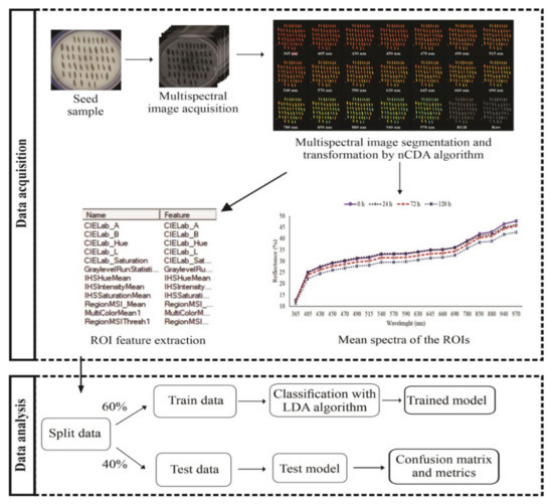
Figure 1.Overall flowchart of the main procedures for multispectral data acquisition and analysis. nCDA-Normalized Canonical Discriminant Analysis. LDA-Linear Discriminant Analysis. ROI-Region Of Interest.
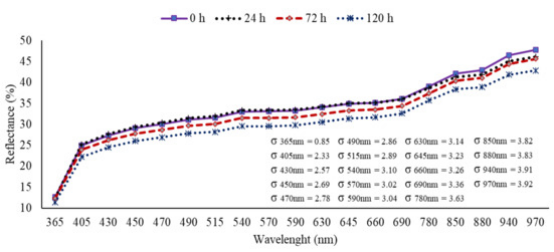
Figure 2.Mean spectral reflectance signatures measured at 19 wavelengths for non-inoculated seeds (0 h) and inoculated seeds with Drechslera avenae (Eidam) Sharif, at 24, 72 and 120 h after inoculation. σ represents the standard deviation (+/?) of reflectance data in each wavelength.
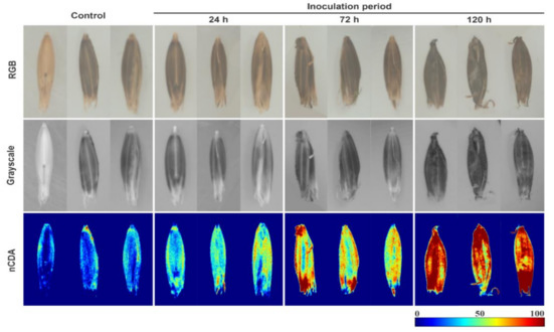
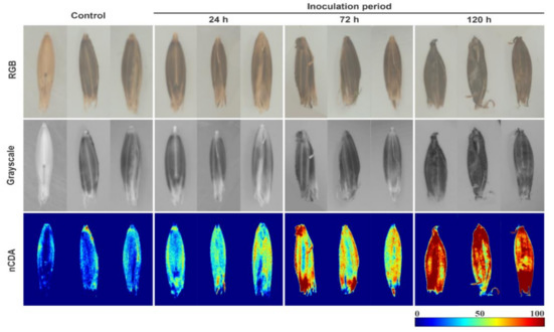
Figure 3.Raw images and corresponding grayscale and nCDA images of black oat seeds at 365 nm for fungus-free seeds (control), and seeds exposed to Drechslera avenae (Eidam) Sharif for 24, 72 and 120 h. In the images transformed by nCDA algorithm, blue color represents healthy tissues, green and yellow colors are intermediate contamination, and red color indicates higher fungal contamination.
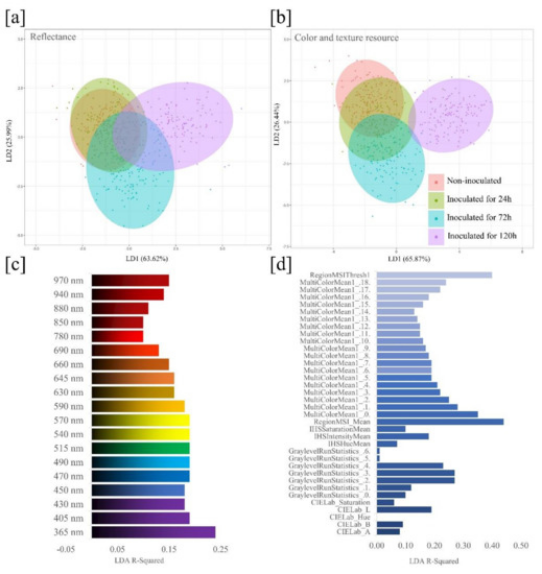
Figure 4. Linear discriminant analysis (LDA) score plot based on reflectance (a) and color and texture resources (b) of black oat seeds for classes of uninoculated and inoculated seeds with Drechslera avenae (Eidam) Sharif. (a, b) Ellipses show 95% confidence intervals for each seed health class. For each class, n = 200. (c) R-squared values indicate the spectral reflectance contributions of 19 wavelengths, and (d) the individual contribution of 36 variables extracted from multispectral images for classification of four seed health classes: 1-uninoculated; 2-inoculated for 24 h; 3-inoculated for 72 h; 4-inoculated for 120 h.