
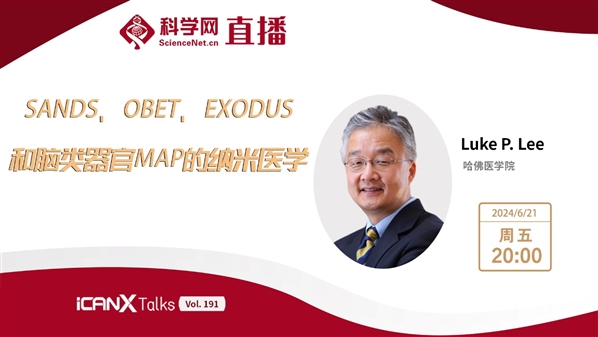
直播時間:2024年6月21日(周五)20:00-21:30
直播平臺:
科學網APP
https://weibo.com/l/wblive/p/show/1022:2321325047709349577279
(科學網微博直播間鏈接)
科學網微博

科學網視頻號
北京時間2024年6月21日晚八點,iCANX Talks 第191期邀請到了哈佛醫學院Luke P. Lee教授進行分享!此外,上海交通大學Xianting Ding,國家納米科學中心Hai Wang,成均館大學Miso Kim,北京大學Haixia Zhang等教授擔任嘉賓,南方科技大學Xingyu Jiang教授擔任主持人。
這將是一場匯聚頂尖學者的盛會,共同探討前沿科技與學術挑戰!更多精彩,敬請期待!
【嘉賓介紹】
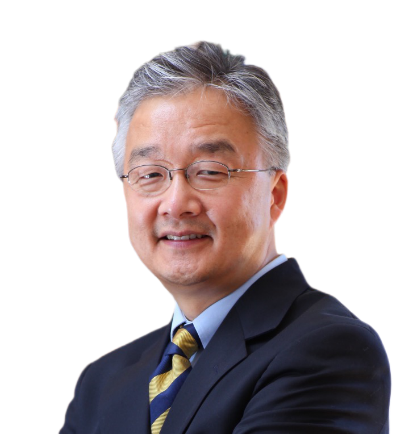
Luke P. Lee
哈佛醫學院
Nanomedicine via SANDs, QBET, EXODUS, and Brain Organoid MAP
【Abstract】
In this talk, I will present smart SANDs (Speedy Analytical Nano-optofluidic Diagnostic systems) to predict and stop the spread of infectious diseases. Smart SANDs refer to advanced molecular diagnostic systems consisting of three primary components: (1) a self-contained on-chip sample preparation and liquid biopsy process, (2) an ultrafast plasmonic amplification method for DNA, RNA and protein biomarkers, and (3) a smartphone optical system interface. Furthermore, nanoplasmonic optical antennas permit QBET (Quantum Biological Electron Transfer) imaging to detect ET dynamics in mitochondrial cytochrome c in living cells. The non-invasive real-time QBET spectroscopic imaging of ET in live cells can open a new era in life sciences since it captures spatiotemporal ET dynamics in live cells. Nanoplasmonic optical antennas can also capture the secret communication codes of the bacterial extracellular vesicles (EVs) to understand better the mechanisms of bacterial communication, pathogenesis, and drug resistance.
I will also discuss how human EVs have emerged as a new paradigm in diagnostics and therapeutics, and the recent progress of EV-based applications of EXODUS (EXOsome Detection via the Ultrafast-purification System). Since the EXODUS by harmonic resonator generates high speed, purity, and yield via automated label-free purification of exosomes from various biofluids, it produces the most sensitive detection of liquid biopsy (from blood, tears, urine, or saliva). For example, the significantly improved purification of exosomes from urine samples of cancer patients enables us to obtain efficient multiomics and compare enriched pathways of kidney and bladder cancer. We also developed iTEARS (integrated Tear Exosome Analysis via Rapid-isolation System) to identify biomarkers of proteins and miRNAs and to see the world of diseases in a drop of tears. EXODUS-based iTEARS can provide a solution to identify numerous other diseases, including infectious diseases, neurodegenerative diseases, and cancers.
For personalized precision nanomedicine, I will present the development of brain organoid MAP (Microphysiological Analysis Platforms) with quantum biosensors and therapeutic modulations of mitochondrial electron transport chains. Human-induced pluripotent stem cells-based brain organoid MAP provides an ideal model to address fundamental questions of neuropathogenesis and find solutions for neurodegenerations. In addition, patient-derived brain organoids can recapitulate patient responses and help personalized medicine. Smart SANDs, QBET, EXODUS, and brain organoid MAPs will impact quantitative life sciences and precision nanomedicine via the convergence of biology, chemistry, physics, and engineering.
在這次演講中,我將介紹智能SANDs(快速分析納米光流體診斷系統),以預測和阻止傳染病的傳播。智能SANDs指的是由三個主要部分組成的先進分子診斷系統:自包含的芯片上樣本制備和液體活檢過程,用于DNA、RNA和蛋白質生物標志物的超快等離子體放大方法,以及智能手機光學系統接口。此外,納米等離子體光學天線允許通過量子生物電子轉移(QBET)成像來檢測活細胞中線粒體細胞色素c中的電子轉移(ET)動態。活細胞中ET的無創實時QBET光譜成像可以開啟生命科學的新時代,因為它捕捉了活細胞中的時空ET動態。納米等離子體光學天線還可以捕捉細菌外泌體(EVs)的秘密通信代碼,以更好地理解細菌通信、致病機制和耐藥性。
我還將討論人類外泌體如何成為診斷和治療的新范式,以及基于外泌體的EXODUS(通過超快速純化系統檢測外泌體)應用的最新進展。由于EXODUS通過諧振器產生高速、純度和產量,通過自動化無標記的外泌體純化系統從各種生物流體中分離外泌體,它提供了最敏感的液體活檢檢測(來自血液、眼淚、尿液或唾液)。例如,從癌癥患者的尿液樣本中顯著改進的外泌體純化使我們能夠獲得高效的多組學數據,并比較腎臟和膀胱癌的富集途徑。我們還開發了iTEARS(通過快速分離系統整合淚液外泌體分析),以識別蛋白質和miRNA的生物標志物,并在一滴眼淚中看到疾病的世界。基于EXODUS的iTEARS可以提供一種解決方案,以識別包括傳染病、神經退行性疾病和癌癥在內的許多其他疾病。
對于個性化精準納米醫學,我將介紹帶有量子生物傳感器和線粒體電子傳遞鏈的治療調節的腦類器官MAP(微生理分析平臺)的開發。基于人類誘導多能干細胞的腦類器官MAP為解決神經病理學的基本原理問題和尋找神經退行性疾病的解決方案提供了理想的模型。此外,來自患者的腦類器官可以再現患者的反應,并幫助個性化醫療。智能SANDs、QBET、EXODUS和腦類器官MAP將通過生物學、化學、物理學和工程學的融合,影響定量生命科學和精準納米醫學。
【BIOGRAPHY】
Luke P. Lee is a Professor at Harvard Medical School. He received his BA in Biophysics and Ph.D. in Applied Physics and Bioengineering from UC Berkeley. He joined the faculty at UC Berkeley in 1999 after more than a decade of industry experience. He became the Arnold and Barbara Silverman Distinguished Professor and the Lester John and Lynne Dewar Lloyd Distinguished Professor at Berkeley. He also served as the Chair Professor in Systems Nanobiology at ETH Zürich. He founded the Biomedical Institute for Global Healthcare Research & Technology (BIGHEART). He served as Associate President for International Research and Innovation and Tan Chin Tuan Centennial Professor at the National University of Singapore. He also founded the Institute for Quantum Biophysics at Sungkyunkwan University, Korea. He has authored over 350 research articles, contributed to four book chapters, and holds 60 international patents. He mentored over 100 undergraduate students, 31 Ph.D. candidates, and 37 post-doctoral fellows, producing 37 faculty members at different universities. He has been honored as a Fellow of the Royal Society of Chemistry and the American Institute of Medical and Biological Engineering. He has also received various awards, such as the IEEE William J. Morlock Award, NSF Career Award, Fulbright Scholar Award, and the HoAm Prize.
Luke P. Lee 是哈佛醫學院的教授,他在加州大學伯克利分校獲得了生物物理學學士學位和應用物理學及生物工程博士學位。在擁有超過十年的工業界經驗后,他于1999年加入了加州大學伯克利分校的教職。他成為了伯克利的阿諾德和芭芭拉·西爾弗曼杰出教授以及萊斯特·約翰和琳恩·德瓦爾·勞埃德杰出教授。他還曾擔任蘇黎世聯邦理工學院系統納米生物學的主席教授。他創立了全球健康研究與技術生物醫學研究所(BIGHEART)。他曾任新加坡國立大學的國際研究與創新協會副會長和陳振傳百年紀念教授。他還在韓國成均館大學創立了量子生物物理研究所。他撰寫了超過350篇研究文章,為四本書撰寫了章節,并持有60項國際專利。他指導了100多名本科生、31名博士生和37名博士后研究員,培養了37名不同大學的教師。他被授予皇家化學學會會員和美國醫學與生物工程學會會員的榮譽。他還獲得了多項獎項,如IEEE威廉·J·莫洛克獎、NSF職業獎、富布賴特學者獎和何安獎。
直播時間:2024年10月11日(周五)20:00-21:30直播平臺:科學網APPhttps://weibo.com/l/wblive/p/show/1022:2321325088295842611......
約翰·霍普菲爾德杰弗里·欣頓。“意外又合理,只是沒想到它獲獎來得如此快。”得知2024年諾貝爾物理學獎頒獎結果,國家納米科學中心研究員高興發如此表示。10月8日,2024年諾貝爾物理學獎頒發給美國普林......
直播時間:2024年9月23日(周一)上午9:00——12:00直播平臺:科學網APPhttps://weibo.com/l/wblive/p/show/1022:232132507998731226......
直播時間:2024年9月19日(周四)19:00直播平臺科學網APP(科學網微博直播間鏈接)https://weibo.com/l/wblive/p/show/1022:232132507699888......
直播時間:2024年9月2日(周一)19:00——20:00直播平臺:科學網APPhttps://weibo.com/l/wblive/p/show/1022:23213250705422930411......
直播時間:2024年8月30日(周五)20:00——21:30直播平臺:科學網APPhttps://weibo.com/l/wblive/p/show/1022:2321325073131739152......
直播時間:2024年9月1日(周日)上午8:00——9:00直播平臺:科學網APP(科學網微博直播間鏈接)https://weibo.com/l/wblive/p/show/1022:23213250......
直播時間:2024年8月20日(周二)20:00——22:00直播平臺科學網APPhttps://weibo.com/l/wblive/p/show/1022:23213250694463......
直播時間:2024年8月21日(周三)18:00——20:00直播平臺:科學網APPhttps://weibo.com/l/wblive/p/show/1022:2321325067673620054......
直播時間:2024年7月23日(星期二)20:00—22:00直播平臺:科學網APP(科學網微博直播間鏈接)https://weibo.com/l/wblive/p/show/1022:2321325......