
原文地址:http://news.sciencenet.cn/htmlnews/2024/3/519759.shtm
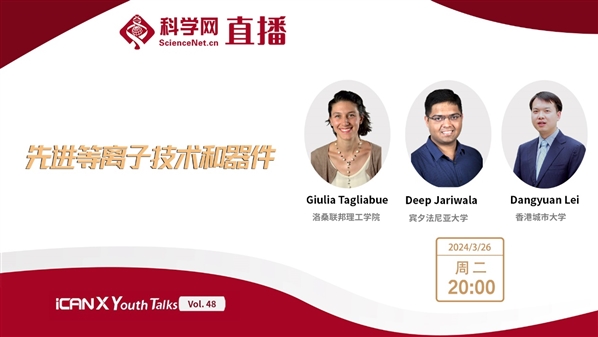
直播時間:2024年3月26日(周二)20:00-22:00
直播平臺:

科學網APP
(科學網微博直播間鏈接)

科學網微博

科學網視頻號
北京時間3月26日晚八點,iCANX Youth Talks第四十八期邀請到了洛桑聯邦理工學院Giulia Tagliabue,賓夕法尼亞大學Deep Jariwala,香港城市大學Dangyuan Lei三位教授主講,西安電子科技大學 Rusen Yang作為主持人,北京大學Haixia Zhang教授擔任嘉賓,期待你一起加入這場知識盛宴。
【嘉賓介紹】

Giulia Tagliabue
洛桑聯邦理工學院
Understanding Hot Carrier Processes For Advanced Plasmonic Energy Devices
【Abstract】
In the last decade, plasmonic nanoantennas have revolutionized light manipulation and control at the nanoscale. Interestingly, hot carriers and photoluminescence in metals have opened new pathways for controlling photo(electro)chemical processes and monitoring temperatures. Yet, fundamental questions remain about the microscopic details of these complex light-matter interactions.
We have recently developed a well-controlled experimental platform based on ultrathin monocrystalline gold flakes [1] that, in combination with theory, enables deeper insight into light absorption and emission processes. In particular, I will show results on the hot carrier dynamics in these systems [2] as well as a study unraveling the origin of luminescence in gold, exploring the role of physical confinement, excitation wavelength and temperature [3]. I will then present micro-scale photoelectrochemical measurements clarifying the interplay of hot carrier generation/transport and quantifying the injection probability of high-energy d-band holes at the metal-electrolyte interface [4], connecting it to the ultrafast dynamics of these carriers in monocrystalline metals. Overall, this microscopic insight is critical to advance the design of plasmonic-based energy devices.
在過去的十年里,等離子納米天線已經徹底改變了納米尺度上的光操控和控制。有趣的是,金屬中的熱載流子和光致發光打開了控制光(電)化學過程和監測溫度的新途徑。然而,關于這些復雜光-物質相互作用的微觀細節仍然存在基本問題。
我們最近開發了一個基于超薄單晶金屬片的良好控制的實驗平臺,結合理論,可以更深入地了解光吸收和發射過程。具體而言,我將展示這些系統中熱載流子動力學的結果,以及一項研究揭示金屬發光起源的研究,探索物理約束、激發波長和溫度的作用。然后,我將提出微觀尺度的光電化學測量結果,闡明熱載流子的產生/輸運相互作用,并量化金屬-電解質界面處高能d帶空穴的注入概率,將其與單晶金屬中這些載流子的超快動態聯系起來。總的來說,這種微觀洞察力對于推進基于等離子體的能源設備的設計至關重要。
【BIOGRAPHY】
Dr. Giulia Tagliabue is a Tenure-track Assistant Professor in the Department of Mechanical Engineering at EPFL. She joined the Engineering faculty in January 2019 where she leads the Laboratory of Nanoscience for Energy Technologies (LNET). She obtained her PhD in Mechanical Engineering from ETH Zurich in 2015. From 2015 to 2018 she was a Swiss National Science Foundation Fellow and she carried on her postdoctoral research jointly at Caltech and the Joint Center for Artificial Photosynthesis (JCAP). Dr. Tagliabue’s research focuses on the study of fundamental mechanisms and nanophotonic-design strategies for light-energy conversion devices, with a special interest for light-energy storage systems. Dr. Tagliabue is the recipient of the First Prize of the Rising Stars of Light Award 2020, the 2021 Early Career Award in Nanophotonics and the 2023 Zellner Prize in Physical Chemistry. In 2020 she was awarded an Eccellenza Grant from SNSF and in 2022 she received an SNSF Starting Grant. She is member of the American Chemical Society (ACS) and the Optical Society of America (Optica). Dr. Tagliabue is currently Managing Editor of the journal Nanophotonics (DeGruyter).
Dr. Giulia Tagliabue是瑞士洛桑聯邦理工學院(EPFL)機械工程系的終身助理教授。她于2019年1月加入工程系,并領導著納米科學能源技術實驗室(LNET)。她于2015年從蘇黎世聯邦理工學院(ETH Zurich)獲得機械工程博士學位。從2015年到2018年,她是瑞士國家科學基金會(Swiss National Science Foundation)的研究員,并在加州理工學院(Caltech)和人工光合作用聯合中心(JCAP)進行博士后研究。Tagliabue博士的研究重點是研究光能轉換設備的基本機制和納米光子設計策略,特別關注光能儲存系統。Tagliabue博士是2020年光之未來新星獎(Rising Stars of Light Award)一等獎、2021年納米光子學早期職業獎和2023年澤爾納物理化學獎(Zellner Prize in Physical Chemistry)的獲得者。2020年,她獲得了瑞士國家科學基金會的Eccellenza資助,2022年獲得了瑞士國家科學基金會的啟動資助。她是美國化學學會(ACS)和美國光學學會(Optica)的成員。Tagliabue博士目前擔任《納米光子學》(Nanophotonics)雜志的主編。

Deep Jariwala
賓夕法尼亞大學
Materials for Low-Power and Extreme-Environment Memory
【ABSTRACT】
Silicon has been the dominant material for electronic computing for decades and very likely will stay dominant for the foreseeable future. However, it is well-known that Moore’s law that propelled Silicon into this dominant position is long dead. Therefore, a fervent search for (i) new semiconductors that could directly replace silicon or (ii) new architectures with novel materials/devices added onto silicon or (iii) new physics/state-variables or a combination of above has been the subject of much of the electronic materials and devices research of the past 2 decades. The above problem is further complicated by the changing paradigm of computing from arithmetic centric to data centric in the age of billions of internet-connected devices and artificial intelligence. Therefore, there is a pressing need for complementing and supplementing Silicon to operate with greater efficiency, speed and handle greater amounts of data. This is further necessary since a completely novel and paradigm changing computing platform (e.g. all optical computing or quantum computing) remains out of reach for now.
The above is however not possible without fundamental innovation in new electronic materials and devices. Therefore, in this talk, I will try to make the case of how novel layered two-dimensional (2D) chalcogenide materials and three-dimensional (3D) nitride materials might present interesting avenues to overcome some of the limitations being faced by Silicon hardware. I will start by presenting our ongoing and recent work on integration of 2D chalcogenide semiconductors with emerging wurtzite structure ferroelectric nitride materials namely aluminium scandium nitride (AlScN). First, I will present on Ferroelectric Field Effect Transistors (FE-FETs) made from 2D materials when integrated with AlScN and make the case for 2D semiconductors in this application. Next, I will introduce our work on Ferroelectric Diode (FeD) devices also based on thin AlScN. In addition, I will also present how FeDs provide a unique advantage in compute-in-memory (CIM) architectures for efficient storage, search as well as hardware implementation of neural networks. Finally, I will present ongoing work and opportunities to extend the application of AlScN memory devices into extreme environments.
硅幾十年來一直是電子計算的主導材料,很可能在可預見的未來仍將保持主導地位。然而,眾所周知,推動硅走向主導地位的摩爾定律早已不復存在。因此,尋找能直接取代硅的新型半導體,或者將新型材料/器件添加到硅上的新體系結構,或者新的物理/狀態變量或以上各項的組合,已成為過去20年電子材料和器件研究的主題。在互聯網時代的數十億連接設備和人工智能的背景下,計算范式從算術中心轉變為數據中心,進一步使上述問題變得更加復雜。因此,迫切需要對硅進行補充和增強,以實現更高效、更快速地處理更多的數據。這是因為目前尚無法完全實現全新的、改變范式的計算平臺(例如全光計算或量子計算)。
然而,在新型電子材料和器件方面進行基礎創新是不可能的。因此,在本次講座中,我將試圖論證新型層狀二維(2D)硫化物材料和三維(3D)氮化物材料可能提供有趣途徑來克服硅硬件面臨的一些限制。我將首先介紹我們關于將2D硫化物半導體與新興的六方結構鐵電氮化物材料,即鋁鈧氮化物(AlScN)的集成工作。首先,我將介紹基于2D材料與AlScN集成的鐵電場效應晶體管(FE-FETs),并闡述在該應用中使用2D半導體的理由。接下來,我將介紹基于薄AlScN的鐵電二極管(FeD)器件。此外,我還將介紹FeD在計算內存(CIM)架構中提供的獨特優勢,用于高效存儲、搜索以及神經網絡的硬件實現。最后,我將介紹將AlScN存儲器件的應用擴展到極端環境的正在進行的工作和機會。
【BIOGRAPHY】
Deep Jariwala is an Associate Professor and the Peter & Susanne Armstrong Distinguished Scholar in the Electrical and Systems Engineering as well as Materials Science and Engineering at the University of Pennsylvania (Penn). Deep completed his undergraduate degree in Metallurgical Engineering from the Indian Institute of Technology in Varanasi and his Ph.D. in Materials Science and Engineering at Northwestern University. Deep was a Resnick Prize Postdoctoral Fellow at Caltech before joining Penn to start his own research group. His research interests broadly lie at the intersection of new materials, surface science and solid-state devices for computing, opto-electronics and energy harvesting applications in addition to the development of correlated and functional imaging techniques. Deep’s research has been widely recognized with several awards from professional societies, funding bodies, industries as well as private foundations the most notable ones being the Optica Adolph Lomb Medal, the Bell Labs Prize, the AVS Peter Mark Memorial Award, IEEE Photonics Society Young Investigator Award, IEEE Nanotechnology Council Young Investigator Award, IUPAP Early Career Scientist Prize in Semiconductors and the Alfred P. Sloan Fellowship. He has published over 150 journal papers with more than 19000 citations and holds several patents.
Deep Jariwala是賓夕法尼亞大學(Penn)電氣與系統工程以及材料科學與工程的副教授,也是彼得和蘇珊·阿姆斯特朗杰出學者。Deep在印度瓦拉納西的印度理工學院獲得金屬工程學士學位,并在西北大學獲得材料科學與工程博士學位。在加入賓夕法尼亞大學之前,Deep在加州理工學院擔任Resnick獎博士后研究員,開始了自己的研究小組。他的研究興趣廣泛涉及新材料、表面科學和固態器件,主要用于計算、光電子學和能量收集應用,以及相關和功能成像技術的發展。Deep的研究得到了專業學會、資助機構、工業界以及私人基金會的廣泛認可,其中最顯著的獎項包括Optica Adolph Lomb獎、貝爾實驗室獎、AVS Peter Mark紀念獎、IEEE光子學會青年研究員獎、IEEE納米技術理事會青年研究員獎、國際純粹與應用物理學會(IUPAP)半導體早期科學家獎和阿爾弗雷德P.斯隆獎學金。他發表了150多篇期刊論文,被引用超過19000次,并持有多項專利。
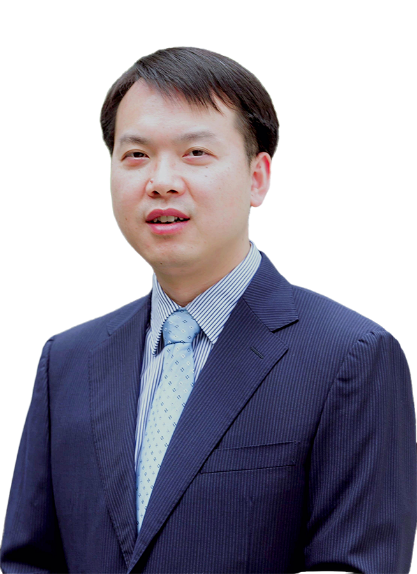
Dangyuan Lei
香港城市大學
Plasmonic Nanocavities for Enhanced Light-Matter Interaction
【ABSTRACT】
Photonic cavities are man-made resonant structures that can confine light in space, typically in the form of standing waves with certain resonance frequencies. Probably the earliest developed cavity system is a pair of mirrors, termed Fabry–Pérot cavity, which is an indispensable component of lasers and interferometers. While such cavities at the macro-scale are important for many optical devices, they really become shining at the micro- and nanoscale, as exemplified by photonic microcavities made of low-loss dielectric materials and plasmonic nanocavities comprised of resonant metallic nanostructures.
In this talk, I will show our recent discoveries of light-induced electromagnetic asymmetry and optical magnetism in symmetry-broken plasmonic nanocavities and their roles in enhancing surface second-harmonic generation. I will then demonstrate that marrying these small-scale photonic cavities with either photo-switchable molecules or low-dimensional quantum materials can realize high-performance functional devices. Finally, I will share my perspectives on unleashing the full potential of hybrid cavity-quantum-materials paradigms for single-molecule quantum sensing and quantum light emission.
光子腔是人造的共振結構,可以將光束在空間中限制,通常以某些共振頻率的駐波形式存在。可能最早開發的腔體系統是一對鏡子,稱為法布里-珀羅腔,它是激光器和干涉儀不可或缺的組件。盡管宏觀尺度上的這種腔體對于許多光學設備至關重要,但它們在微觀和納米尺度上才真正發揮作用,例如由低損耗介質材料制成的光子微腔和由共振金屬納米結構組成的等離子體納米腔。
在本次演講中,我將展示我們最近在對稱破缺等離子體納米腔中發現的光誘導電磁不對稱性和光學磁性,以及它們在增強表面二次諧波發生中的作用。然后,我將證明將這些小尺度的光子腔與光開關分子或低維量子材料結合起來,可以實現高性能的功能性器件。最后,我將分享我對釋放混合腔體-量子材料范式的全部潛力,用于單分子量子傳感和量子光發射的觀點。
【BIOGRAPHY】
Dangyuan LEI is a Professor in the Department of Materials Science and Engineering at City University of Hong Kong and the Provost’s Visiting Professor of Physics at Imperial College London. He received his PhD degree in Physics from Imperial College London in 2011, with his thesis awarded the Anne Thorne PhD Thesis Prize. His research interest centers on plasmonic nanophotonics, low-dimensional quantum optical materials and the nanoscale cavity-matter interaction and device applications. He has published 220 publications, received 13000 citations and an h-index of 63. Three of his publications have been highlighted as “Editor’s Choice” of Science and “Research Highlights” of Nature Materials respectively. He is an elected member of the Hong Kong Young Academy of Sciences, an OSA Senior Member, a member of SPIE, IOP and PSHK, and a National Science and Technology Expert of MOST. He was the only representative of Hong Kong for the APEC Science Prize for Innovation, Research & Education (ASPIRE, 2021) and received an Outstanding Research Award for Junior Faculty from City University of Hong Kong (2021), Rising Star Lectureship in Materials Science from Hong Kong Institute of Advanced Study (2021), Shanxi Science and Technology Award (2021), Excellent Young Scientists Fund for Hong Kong & Macau from National Natural Science Foundation of China (2020), and Young Innovators Award in 2D Materials from Nano Research (2020).
Dangyuan Lei是香港城市大學材料科學與工程系的教授,也是倫敦帝國學院物理系的校務長訪問教授。他于2011年從倫敦帝國學院獲得物理學博士學位,其論文榮獲安妮·索恩博士論文獎。他的研究興趣集中在等離子體納米光子學、低維量子光學材料以及納米尺度腔體-物質相互作用和器件應用。他發表了220篇論文,被引用13000次,h指數為63。他的三篇論文分別被《科學》雜志和《自然材料》雜志選為“編輯之選”和“研究亮點”。他是香港青年科學院的選舉成員,是OSA的高級會員,也是SPIE、IOP和PSHK的成員。他是2021年亞太經合組織創新、研究與教育科學獎(ASPIRE)的香港唯一代表,并獲得了香港城市大學的優秀青年教師研究獎(2021年)、香港高等研究學院材料科學領域的新星講座獎(2021年)、2021年山西科技獎、以及《納米研究》雜志2D材料領域的青年創新獎(2020年)。
【主持人】
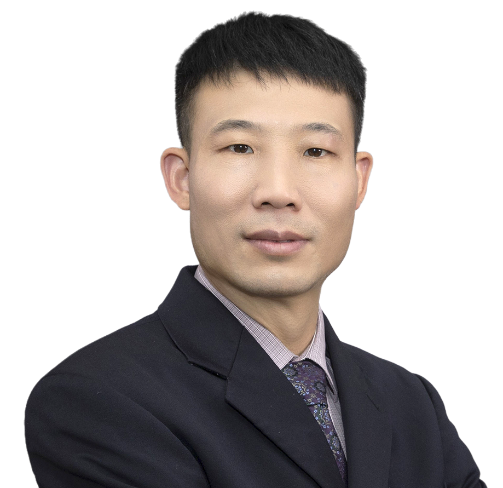
Rusen Yang
西安電子科技大學
【研討嘉賓】

Haixia Zhang
直播時間:2024年10月11日(周五)20:00-21:30直播平臺:科學網APPhttps://weibo.com/l/wblive/p/show/1022:2321325088295842611......
直播時間:2024年9月23日(周一)上午9:00——12:00直播平臺:科學網APPhttps://weibo.com/l/wblive/p/show/1022:232132507998731226......
直播時間:2024年9月19日(周四)19:00直播平臺科學網APP(科學網微博直播間鏈接)https://weibo.com/l/wblive/p/show/1022:232132507699888......
直播時間:2024年9月2日(周一)19:00——20:00直播平臺:科學網APPhttps://weibo.com/l/wblive/p/show/1022:23213250705422930411......
直播時間:2024年8月30日(周五)20:00——21:30直播平臺:科學網APPhttps://weibo.com/l/wblive/p/show/1022:2321325073131739152......
直播時間:2024年9月1日(周日)上午8:00——9:00直播平臺:科學網APP(科學網微博直播間鏈接)https://weibo.com/l/wblive/p/show/1022:23213250......
直播時間:2024年8月20日(周二)20:00——22:00直播平臺科學網APPhttps://weibo.com/l/wblive/p/show/1022:23213250694463......
直播時間:2024年8月21日(周三)18:00——20:00直播平臺:科學網APPhttps://weibo.com/l/wblive/p/show/1022:2321325067673620054......
直播時間:2024年7月23日(星期二)20:00—22:00直播平臺:科學網APP(科學網微博直播間鏈接)https://weibo.com/l/wblive/p/show/1022:2321325......
原文地址:http://news.sciencenet.cn/htmlnews/2024/7/525979.shtm直播時間:2024年7月9日(周二)19:00直播平臺:科學網APP(科學網微博直播......