
One type of tracking material is a spark chamber, which is a gas-filled region criss-crossed with wires. Another type of tracking material is silicon strip detectors, which consists of two planes of silicon. In one plane the strips are oriented in the "x"-direction, while the other plane has strips in the "y"-direction. The position of a particle passing through these two silicon planes can be determined more precisely than in a spark chamber.
By reconstructing the tracks of the charged pair as it passes through the vertical series of trackers, the gamma-ray direction, and therefore its origin on the sky, are calculated. In addition, through the analysis of the scattering of the pair (which is an energy-dependent phenomenon) or through the absorption of the pair by a scintillator detector or a calorimeter after they exit the spark chamber, the total energy of the initial gamma-ray is determined.
This animation shows how the Large Area Telescope on the Fermi Gamma-ray Telescope works. A gamma ray (purple) interacts with the detector, creating an electron-positron pair which cascade down the tower. Using the paths that the electron and positron take through the telescope, the direction of the original gamma-ray can be determined (shown in purple). (Credit: NASA's Goddard Space Flight Center Conceptual Image Lab)
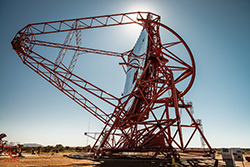
Photo of one of the HESS telescopes. The HESS array detects Cerenkov light from high energy gamma rays entering the Earth's atmosphere. (Credit: HESS Collaboration)
While a typical gamma-ray detector must be flown with a balloon or on a satellite above the Earth's atmosphere to avoid absorption of the gamma-ray photon, the air Cerenkov telescope makes the atmosphere part of the detector. When gamma rays encounter Earth's atmosphere, they create an "air shower." This process involves the original photon undergoing a pair production interaction high up in the atmosphere, creating an electron and positron. These particles then interact, through bremsstrahlung and Compton scattering, and give up some of their energy to create energetic photons. These in turn create more electrons, resulting in a cascade of electrons and photons that travel down through the atmosphere until the particles run out of energy.
These are extremely energetic particles, which means that they are traveling very close to the speed of light. In fact, these particles are traveling faster than the speed of light "in the medium of the atmosphere." Remember that nothing can travel faster than the speed of light in a vacuum, but that the speed of light is reduced when traveling through most materials (like glass, water and air). The resultingpolarization of local atoms as the charged particles travel through the atmosphere results in the emission of a faint, bluish light known as "Cerenkov radiation", named for Pavel Cerenkov, the Russian physicist who made comprehensive studies of this phenomenon.
Depending on the energy of the initial cosmic gamma ray, there may be thousands of electrons/positrons in the resulting cascade that are capable of emitting Cerenkov radiation. As a result, a large "pool" of Cerenkov light accompanies the particles in the air shower. Air Cerenkov detectors, as the name implies, rely on the detection of this pool of light to detect the arrival of a cosmic gamma ray.
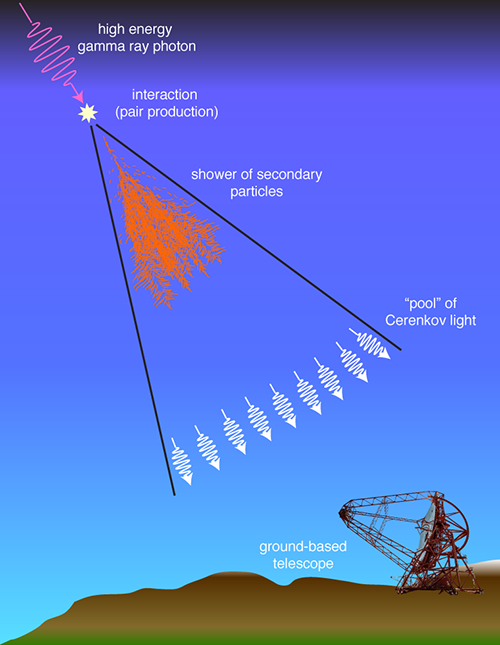
Illustration of the process of detecting a gamma ray using Earth's atmosphere. (Credit: Diagram by NASA's Imagine the Universe; telescope image from the HESS Collaboration)
Air Cerenkov detectors begin with one or many large optical reflectors, and are usually placed at mountain sites where standard optical observatories might be located. The mirrors used can be of lesser quality than those used in optical telescopes, since they are reflecting the light of this large local pool rather than directly imaging an astronomical source. The Cerenkov light reflected from this mirror is then detected in the focal plane by one or many photomultipliers that convert the optical signal into an electronic signal to record the gamma-ray event. The light in this pool is very faint and can only be detected cleanly on dark, moonless nights. Even so, it helps that the total pool passes through the detector in only a few nanoseconds. This allows further separation of the faint signal from the ambient light from the rest of the night sky.
Once the light has been detected in a phototube, fast electronics are used to record the signal. Many modern detectors use an array of 100 or more small phototubes in the focal plane rather than a single phototube. In this way, a crude image of the Cerenkov light pool is recorded. This is very important because these detectors, in addition to detecting cosmic gamma-ray photons, detect a large cosmic ray background. Cosmic ray protons and nuclei interact in the atmosphere in much the same way, creating their own Cerenkov light pools. These showers induced by cosmic rays come uniformly from all parts of the sky and mask the desired photonic signal. Less than 1% of the events detected are due to photons. The rest are cosmic rays.
Updated: October 2013
https://imagine.gsfc.nasa.gov/science/toolbox/gamma_detectors2.html
gamma ray產生原理
放射性原子核在發生α衰變、β衰變后產生的新核往往處于高能量級,要向低能級躍遷,輻射出γ光子。原子核衰變和核反應均可產生γ射線。其為波長短于0.2埃的電磁波[3] 。γ射線的波長比X射線要短,所以γ射線具有比X射線還要強的穿透能力。
伽馬射線是頻率高于1.5 千億億 赫茲的電磁波光子。伽馬射線不具有電荷及靜質量,故具有較α粒子及β粒子弱之電離能力。伽馬射線具有極強之穿透能力及帶有高能量。伽馬射線可被高原子數之原子核阻停,例如鉛或乏鈾。
gamma ray測量方法
γ光子不帶電,故不能用磁偏轉法測出其能量,通常利用γ光子造成的上述次級效應間接求出,例如通過測量光電子或正負電子對的能量推算出來。此外還可用γ譜儀(利用晶體對γ射線的衍射)直接測量γ光子的能量。
由熒光晶體、光電倍增管和電子儀器組成的閃爍計數器是探測γ射線強度的常用儀器。