
當超高能的伽馬射線猛烈撞擊地球大氣層時,它們會引發粒子雨,并釋放出一種昏暗的藍光。利用這種光,天文學家可以追蹤罕見的伽馬射線(每平方米的大氣每月只會發生幾次撞擊)直至它們的源頭——宇宙中的一些劇烈事件,例如特大質量黑洞。
伽馬射線是原子核能級躍遷蛻變時釋放出的射線,是波長短于0.2埃的電磁波。伽馬射線有很強的穿透力,工業中可用來探傷或流水線的自動控制。伽馬射線對細胞有殺傷力,醫療上用來治療腫瘤
Gamma-rays pass through most materials, so they cannot be reflected by a typical mirror as for optical photons, or using a special configuration of mirrors, as for X-ray photons. However, the tools of high-energy physics are used to detect and characterize gamma-ray photons and allow scientists to observe the cosmos up to energies of 1 TeV (1,000,000,000,000 eV, where an optical photon has an energy of a few eV) and beyond.
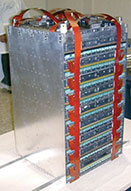
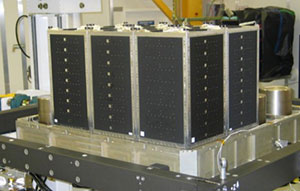
Photos of detector towers for the Large Area Telescope on Fermi. On the left is a single tower, which is composed of a stack of interleaved planes of silicon strips and tungsten converters. On the right is a photo showing six towers installed on the detector housing. The LAT has 16 of these towers in a 4x4 array. (Credit: NASA/Fermi)
Gamma-ray detectors can be placed in two broad classes. The first class includes what would typically be called spectrometers or photometers in optical astronomy. These instruments are "light buckets" that focus on a region of the sky containing the target and collect as many photons as possible. These types of detectors typically use scintillators or solid-state detectors to transform the gamma-ray into optical or electronic signals, which are then recorded.
The second class includes detectors that perform the difficult task of gamma-ray imaging. Detectors of this type either rely on the nature of the gamma-ray interaction process such as pair production or Compton scattering to calculate the arrival direction of the incoming photon, or use a device such as a coded-mask to allow an image to be reconstructed.
The operation of scintillation and solid state detectors for gamma-ray astronomy is the same as it is for X-ray astronomy. We've described the basics of these types of detectors on the X-ray Detector page. Below we describe three types of detectors used uniquely for gamma-ray astronomy: Compton scattering detectors, pair telescopes, and air Cerenkov detectors.
The region from about 1 to 30 MeV is a difficult part of the gamma-ray astronomy energy range to study, but it can be interesting. In this energy range, astronomers can study nuclear emission lines, some pulsars, active galaxies, solar flares and gamma-ray bursts. This is also the energy range where Compton scattering is the dominant physical interaction between light and matter. Compton scattering occurs when a photon hits an electron and some of the photon energy is transferred to the charged particle. The Compton scatter telescope design uses this interaction as the basis of its detection scheme.
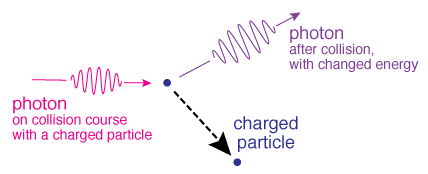
Illustration of a Compton scatter interaction. (Credit: NASA's Imagine the Universe)
Compton scatter telescopes are typically two-level instruments. In the top level, the cosmic gamma-ray Compton scatters off an electron in a scintillator. The scattered photon then travels down into a second level of scintillator material that completely absorbs the scattered photon. Phototubes viewing the two levels can approximately determine the interaction points at the two layers and the amount of energy deposited in each layer.
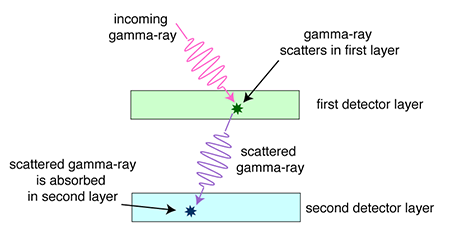
Illustration of a the basic operation of a Compton scattering detector. (Credit: NASA's Imagine the Universe)
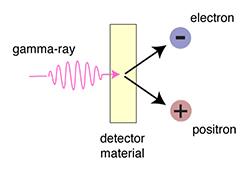
Illustration of the basic interaction in a pair-production telescope. (Credit: NASA's Imagine the Universe)
The pair telescope is a technology that was borrowed directly from the world of high-energy physics. At energies above about 30 MeV, pair production is the dominant photon interaction in most materials. A pair telescope uses this process to detect the arrival of the cosmic photon through the electron/positron pair created in the detector.
The standard instrument design is to have a layered telescope, with converter layers interleaved with tracking material. The converter is typically a heavy metal, such as lead, which provides the target for creating the initial pair. The tracking material detects the pair. Once the electron/positron pair has been created in one of the converter layers, they traverse the chamber, ionizing the gas. Triggering the detector electrifies the wires, attracting the free electrons and providing the detected signal. The trail of sparks provides a three-dimensional picture of the electron/positron paths.