
編譯 | 李言
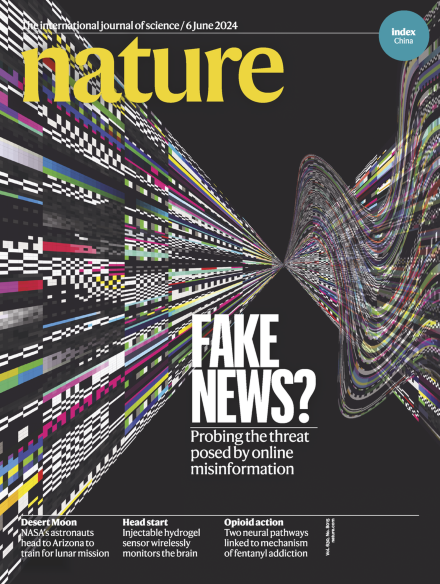
Nature, 6 June 2024, Volume 630 Issue 8015
《自然》2024年6月6日,第630卷,8015期
化學Chemistry
Metals strengthen with increasing temperature at extreme strain rates
在極端應變速率下,金屬隨溫度升高而增強
▲ 作者:Ian Dowding & Christopher A. Schuh
▲ 鏈接:
https://www.nature.com/articles/s41586-024-07420-1
▲ 摘要:
在此,在應變率大于 106s1且沒有沖擊合并的情況下進行微彈道沖擊測試,我們發現溫度升高157°C后,銅的強度增加了約30%,在純鈦和金上也觀察到了這種效果。這種效應是違反直覺的,因為正常條件下,幾乎所有材料加熱時會變軟。
這幾種純金屬的異常熱強化是控制變形機制發生變化的結果,從熱激活強化到位錯的彈道輸運,位錯通過聲子相互作用經歷阻力。研究結果指出了一條從高速制造操作到高超音速運輸,能更好建模和預測各種極端應變率條件下材料性能的途徑。
▲ Abstract:
Here, with microballistic impact testing at strain rates greater than 106s1, and without shock conflation, we show that the strength of copper increases by about 30% for a 157°C increase in temperature, an effect also observed in pure titanium and gold. This effect is counterintuitive, as almost all materials soften when heated under normal conditions. This anomalous thermal strengthening across several pure metals is the result of a change in the controlling deformation mechanism from thermally activated strengthening to ballistic transport of dislocations, which experience drag through phonon interactions. These results point to a pathway to better model and predict materials properties under various extreme strain rate conditions, from high-speed manufacturing operations to hypersonic transport.
Photocatalytic doping of organic semiconductors
有機半導體的光催化摻雜
▲ 作者:Wenlong Jin, Chi-Yuan Yang et.al
▲ 鏈接:
https://www.nature.com/articles/s41586-024-07400-5
▲ 摘要:
在此,我們報告了光催化摻雜OSCs,該方法可以在室溫下使用空氣作為弱氧化劑(p型摻雜)進行操作。這是一種可以應用于各種OSCs和光催化劑的通用方法,產生超過3000 S cm–1的電導率。
我們還展示了成功的光催化還原(n型摻雜),以及同時p型摻雜和n型摻雜的OSCs,其中用于保持電荷中性的有機鹽是唯一消耗的化學物質。我們的光催化摻雜方法為推進OSC摻雜和開發下一代有機電子器件提供了巨大的潛力。
▲ Abstract:
Here, we report a previously undescribed concept for the photocatalytic doping of OSCs that uses air as a weak oxidant (p-dopant) and operates at room temperature. This is a general approach that can be applied to various OSCs and photocatalysts, yielding electrical conductivities that exceed 3,000Scm–1. We also demonstrate the successful photocatalytic reduction (n-doping) and simultaneous p-doping and n-doping of OSCs in which the organic salt used to maintain charge neutrality is the only chemical consumed. Our photocatalytic doping method offers great potential for advancing OSC doping and developing next-generation organic electronic devices.
物理學Physics
Dispersion-assisted high-dimensional photodetector
色散輔助高維光電探測器
▲ 作者:Yandong Fan, Weian Huang et.al
▲ 鏈接:
https://www.nature.com/articles/s41586-024-07398-w
▲ 摘要:
在此,我們證明了具有空間和頻率色散的簡單薄膜界面可以在波矢量域中投射和定制偏振和頻譜響應。通過這種方法,我們可以將高維光信息編碼成單次成像,并借助深度殘差網絡解碼。
我們的研究不僅可以通過單一設備和單次測量在寬帶頻譜上實現任意混合全斯托克斯偏振態的光的全面表征,而且還能提供與最先進的單一用途小型化偏光計或光譜儀相媲美的性能。
▲ Abstract:
Here we demonstrate that simple thin-film interfaces with spatial and frequency dispersion can project and tailor polarization and spectrum responses in the wavevector domain. By this means, high-dimensional light information can be encoded into single-shot imaging and deciphered with the assistance of a deep residual network. To the best of our knowledge, our work not only enables full characterization of light with arbitrarily mixed full-Stokes polarization states across a broadband spectrum with a single device and a single measurement but also presents comparable, if not better, performance than state-of-the-art single-purpose miniaturized polarimeters or spectrometers。
天文學Astronomy
Star formation shut down by multiphase gas outflow in a galaxy at a redshift of 2.45
在一個紅移為2.45的星系中,多相氣體流出終止了恒星的形成
▲ 作者:Sirio Belli, Minjung Park et.al
▲ 鏈接:
https://www.nature.com/articles/s41586-024-07412-1
▲ 摘要:
在此,我們報告了在紅移2.445處經歷快速淬滅的大質量星系的JWST光譜分析結果。我們探測到微弱的電離氣體流出和強大的中性氣體流出,其質量流出率足以熄滅恒星形成。
我們沒有檢測到X射線和無線電活動;但是電離氣體發射譜線的特性暗示了超大質量黑洞的存在。由此我們認為,超大質量黑洞能夠通過有效地噴射中性氣體來迅速抑制大質量星系中恒星的形成。
▲ Abstract:
Here we report JWST spectroscopy of a massive galaxy experiencing rapid quenching at a redshift of 2.445. We detect a weak outflow of ionized gas and a powerful outflow of neutral gas, with a mass outflow rate that is sufficient to quench the star formation. Neither X-ray nor radio activity is detected; however, the presence of a supermassive black hole is suggested by the properties of the ionized gas emission lines. We thus conclude that supermassive black holes are able to rapidly suppress star formation in massive galaxies by efficiently ejecting neutral gas.
生物學Biology
Life-cycle-coupled evolution of mitosis in close relatives of animals
動物近緣中有絲分裂的生命周期耦合演化
▲ 作者:Hiral Shah, Marine Olivetta et.al
▲ 鏈接:
https://www.nature.com/articles/s41586-024-07430-z
▲ 摘要:
在此,我們使用比較基因組學和超微結構成像的綜合方法來研究動物和真菌的近親Ichthyosporea的有絲分裂策略。
我們發現這個分支中的物種已經分化為真菌樣的閉合有絲分裂或動物樣的開放有絲分裂,可能是為了支持不同的多核或無核狀態。我們的研究結果表明,多核生命周期有利于閉合有絲分裂的演化。
▲ Abstract:
Here we use an integrated comparative genomics and ultrastructural imaging approach to investigate mitotic strategies in Ichthyosporea, close relatives of animals and fungi. We show that species in this clade have diverged towards either a fungal-like closed mitosis or an animal-like open mitosis, probably to support distinct multinucleated or uninucleated states. Our results indicate that multinucleated life cycles favour the evolution of closed mitosis.
醫學Medicine
A whole-slide foundation model for digital pathology from real-world data
基于真實世界數據的全切片數字病理學模型
▲ 作者:Hanwen Xu, Naoto Usuyama et.al
▲ 鏈接:
https://www.nature.com/articles/s41586-024-07441-w
▲ 摘要:
在此,我們展示Prov-GigaPath。這是一個全切片病理學基礎模型,它對來自美國普羅維頓斯市的171189張全切片中的13億張256 × 256病理圖像進行了預訓練。普羅維頓斯市有28個癌癥中心。
這些切片來自涵蓋31種主要組織類型的3萬多名患者。為了預訓練Prov-GigaPath,我們提出了一種新的視覺轉換器架構GigaPath,用于預訓練十億像素的病理切片。為了將GigaPath擴展到具有數萬個圖像塊的切片級學習,GigaPath將新開發的LongNet方法應用于數字病理學。
為了評估Prov-GigaPath,我們同時使用來自普羅維頓斯市和TCGA數據構建了一個數字病理基準,包括9個癌癥亞型任務和17個病理任務。通過大規模預訓練和超大上下文建模,Prov-GigaPath在26個任務中的25個任務上達到了最先進的性能,在18個任務上比其他方法有了顯著改進。
結合病理報告,我們進一步證明了Prov-GigaPath在病理視覺語言預訓練方面的潛力。綜上,Prov-GigaPath是一種可在各種數字病理任務中實現最先進的性能的開放權重基礎模型,它證明了真實世界數據和全切片建模的重要性。
▲ Abstract:
Here we present Prov-GigaPath, a whole-slide pathology foundation model pretrained on 1.3 billion 256×256 pathology image tiles in 171,189 whole slides from Providence, a large US health network comprising 28 cancer centres. The slides originated from more than 30,000 patients covering 31 major tissue types. To pretrain Prov-GigaPath, we propose GigaPath, a novel vision transformer architecture for pretraining gigapixel pathology slides. To scale GigaPath for slide-level learning with tens of thousands of image tiles, GigaPath adapts the newly developed LongNet method to digital pathology. To evaluate Prov-GigaPath, we construct a digital pathology benchmark comprising 9 cancer subtyping tasks and 17 pathomics tasks, using both Providence and TCGA data. With large-scale pretraining and ultra-large-context modelling, Prov-GigaPath attains state-of-the-art performance on 25 out of 26 tasks, with significant improvement over the second-best method on 18 tasks. We further demonstrate the potential of Prov-GigaPath on vision–language pretraining for pathology by incorporating the pathology reports. In sum, Prov-GigaPath is an open-weight foundation model that achieves state-of-the-art performance on various digital pathology tasks, demonstrating the importance of real-world data and whole-slide modelling.